
Wednesday, 17 February 2010


Football: Senior Honours v Econ Academics
The staff have started training for the this year's Academics v Senior Honours football match so I thought I would re-post the photos and video of the March 2009 match.


Everyone enjoyed themselves and the staff upheld the reputation of the School by winning 2-0. Santi and Ahmed were the goal-scorers.
Here's a short video of the game:


Everyone enjoyed themselves and the staff upheld the reputation of the School by winning 2-0. Santi and Ahmed were the goal-scorers.
Here's a short video of the game:
This year, we're going to draw the SH team members' names out of a hat during the coming SH party (Thursday 4th March - in the coffee room, 1st floor, 31 BP, 4pm) and the game itself will be towards the end of March. If you want to put your name forward for the team, just email Karen or Christina on Economics.SSO@ed.ac.uk and we'll put you on the list.
Wednesday, 10 February 2010
Economics needs you!
We are currently looking for participants to take part in our focus groups. Would you like to help shape the future of the Economics student experience at Edinburgh? If so, we would love to hear your positives and negatives of studying here!
If you are willing to spare 50 minutes of your time next week (w/c 15 February 2010) please contact us at:
Economics.SSO@ed.ac.uk
Tea and coffee will be provided, and all participants will be rewarded with a University of Edinburgh Economics mug.
If you are willing to spare 50 minutes of your time next week (w/c 15 February 2010) please contact us at:
Economics.SSO@ed.ac.uk
Tea and coffee will be provided, and all participants will be rewarded with a University of Edinburgh Economics mug.
Thursday, 4 February 2010
Poster Sessions
The poster sessions are coming up soon and we thought we'd post a video of the November session so you can get an idea of what it'll be like.
Wednesday, 27 January 2010
Keynes, Hayek, Booms and Busts
This morning a friend of mine sent me this link:
http://www.youtube.com/watch?v=d0nERTFo-Sk
It's a video. A rap music video. With economic theory in it! Keynes and Hayek return to life to attend the "World Economic Summit". Keynes suggests that he and Hayek go out for a night on the town, during which they each outline their theory of booms and busts, all in the company of pretty ladies and ample amounts of alcohol (and a barman who is eager to serve).
It was a good start to my day. The video is really well done, and there are so many well thought-of details; even the barman serving the shots looks a bit like Bernanke (and his name is Ben)! Kudos to John Papola and Russ Roberts, and to the main actors, Billy Scafuri (John Maynard Keynes) and Adam Lustick (F. A. Hayek).
If you like their project, go to their website at http://www.econstories.tv to read more about the project and those behind it, and to donate for what's coming next. May there be lots more!!
http://www.youtube.com/watch?v=d0nERTFo-Sk
It's a video. A rap music video. With economic theory in it! Keynes and Hayek return to life to attend the "World Economic Summit". Keynes suggests that he and Hayek go out for a night on the town, during which they each outline their theory of booms and busts, all in the company of pretty ladies and ample amounts of alcohol (and a barman who is eager to serve).
It was a good start to my day. The video is really well done, and there are so many well thought-of details; even the barman serving the shots looks a bit like Bernanke (and his name is Ben)! Kudos to John Papola and Russ Roberts, and to the main actors, Billy Scafuri (John Maynard Keynes) and Adam Lustick (F. A. Hayek).
If you like their project, go to their website at http://www.econstories.tv to read more about the project and those behind it, and to donate for what's coming next. May there be lots more!!
Monday, 25 January 2010
On why killing three billion people may not be such a bad idea
 During a recent coffee conversation, members of the faculty were discussing on the difficulties of establishing Pareto optimality in situations with an infinite horizon. In cases like those, it is complex to ascertain what schedule of taxes and transfers from one generation to another can make all generations better off. At some point the conversation arrived at an extreme example: Suppose we kill half the population of the planet, that is, three billion people. That will ensure that global warming will not take place, that valuable resources will remain unexploited and that pollution will not ruin the environment forever. That is, the potential gains for future generations from an exercise like that are huge. The next step would be to compensate the three billion people we are about to kill in order to ensure a Pareto improvement. We could throw them a party wild and big enough to leave them indifferent between dying just after it ends or continue living. That is reminiscent of that old sci-fi film called Logan’s Run (in the photo) in which people in a dystopian society were “renewed” when they turned 30 in the middle of a ceremony with great celebration and joy. The incredible welfare gains derived from having half the population of the planet exterminated should be enough to compensate those who are killed and that would ensure Pareto optimality. There is however an obvious problem with this scheme: Those gains will take place in the future. Only after the three billion people are dead the rivers and the air will become clean, the level of the sea will stop threatening millions of people living in the coast and humans will avoid extinction. Unfortunately, those large welfare gains cannot be transferred from the future.
At this point you may be horrified. Morally, the idea of killing half of the Earth’s population seems repulsive at first glance. But what if it ensures the survival of the human race? Let’s put in a different way. Suppose now that people care about the welfare of their children and of their grandchildren. In that case, the transfer necessary to leave them indifferent between dying or not (the size of the party) may not be that big if by leaving things as they are their descendants will face extinction or, even worse, a miserable life. Maybe, just maybe, the total amount needed to compensate those three billion people is not that big and it can be generated by the current generation...
... This is what happens when you take economic reasoning to its last consequences.
Monday, 18 January 2010
Are economists cheapskates?
 Happy new year to everybody!
Economists are widely regarded as heartless bastards. It is assumed that we only care about money and profits and that we disregard ethics and morals. That, as with all clichés, contains a small element of truth. Surveys and experiments have shown that it is not that economists are bad people, it is just that they care more about efficiency. Given that, as you should know, efficiency and equity are frequently in conflict with each other, economists may look stingy and cold. Economic training is to "blame" for this. Economics students learn concepts like opportunity cost or learn to think strategically by studying game theory. When taken seriously and when applied to everyday life, these ideas can make a person behave in apparently bizarre and cheap ways.
This is the topic of this very nice article, kindly contributed by our student Ankita Patnaik. It is a comprehensive overview of the reasons behind our apparent coldness. To some extent it is true that we are less averse to put a price to things like time. But on the other hand, as we have argued elsewhere in this blog, being a "bastard", that is, caring about efficiency and being realistic about people's motivations can often be the best way to improve their welfare and make the world a better place.
A final question for you students: Do you feel that your "dark side" is growing as as your economic studies progress?
Monday, 21 December 2009
Paul Samuelson
 It would be a shame if we did not to mention in this blog the recent death of Paul Samuelson, the "Father of Modern Economics", who passed away on December 13th, age 94. The legacy of Samuelson is inmense. The breadth of his work, astounding. He changed completely every single field in which he worked, either Microeconomics, Macroeconomics, Public Finance or International Economics. He was responsible for ideas and concepts now essential to every economist, like revealed preference, comparative statics, social welfare functions, and jointly with Robert Solow, he made explicit the conjecture behind the Philips´curve. He also contributed to the incorporation of mathematical tools (from thermodynamics in particular) into economic analysis, and he laid down the two main features that distinguish Economics from other social sciences: That agents hold well-defined objectives that they seek to attain and the notion of equilibrium. His book Economics (1948) has been studied by dozens of generations of undergraduate economists.
The Great Depression motivated him to become an economist. The hardships of those turbulent times left a longlasting impression on him. He was economic advisor to John F. Kennedy and Lyndon B. Johnson. As a Neo-Keynesian, he always advocated the necessity of the intervention of the State in the operations of markets. Last year, just after the explosion of the financial crisis, he wrote "Farewell to Friedman-Hayek libertarian capitalism," an incendiary piece against the Bush administration, the free-market triumphalists and their theorists. Reading it is a good way to remember this giant and to preserve his legacy.
Wednesday, 16 December 2009
More Economics posters
The site Behance network hosts a project by Gokhun Guneyhan called Cogito Ergo Sum, featuring posters dedicated to famous philosophers. They are all pretty cool but the most interesting to us is of course the one devoted to Adam Smith. Simple but effective. I think old Adam would have liked it.


Monday, 16 November 2009
"SuperFreakonomics" has some ideas for reëngineering the planet
A recent article in the New Yorker takes issues with the solutions for climate change proposed by the authors of a new book “SuperFreakonomics: Global Cooling, Patriotic Prostitutes, and Why Suicide Bombers Should Buy Life Insurance” by economics Professor Steven D. Levitt and journalist Stephen J. Dubner.
According to Levitt and Dubner, the story’s message is a simple one: if, at any particular moment, things look bleak, it’s because people are seeing them the wrong way. “When the solution to a given problem doesn’t lie right before our eyes, it is easy to assume that no solution exists,” they write. “But history has shown again and again that such assumptions are wrong.” As usual, they say, the anxiety is unwarranted.
First, the globalwarming threat has been exaggerated; there is uncertainty about how, exactly, the earth will respond to rising CO2 levels, and uncertainty has “a nasty way of making us conjure up the very worst possibilities.”
Second, solutions are bound to present themselves: “Technological fixes are often far simpler, and therefore cheaper, than the doomsayers could have imagined."
Levitt and Dubner, reports the New Yorker, have in mind a very particular kind of “technological fix.” One scheme that Levitt and Dubner endorse features a fleet of fibreglass boats equipped with machines that would increase the cloud cover over the oceans. Another calls for constructing a vast network of tubes for sucking cold water from the depths of the sea to the surface. Far and away their favorite plan involves mimicking volcanoes.
To which New Yorker journalist, Elizabeth Kolbert responds:
If you want to read more, go here: The New Yorker by Elizabeth Kolbert, Nov. 15, 2009.
According to Levitt and Dubner, the story’s message is a simple one: if, at any particular moment, things look bleak, it’s because people are seeing them the wrong way. “When the solution to a given problem doesn’t lie right before our eyes, it is easy to assume that no solution exists,” they write. “But history has shown again and again that such assumptions are wrong.” As usual, they say, the anxiety is unwarranted.
First, the globalwarming threat has been exaggerated; there is uncertainty about how, exactly, the earth will respond to rising CO2 levels, and uncertainty has “a nasty way of making us conjure up the very worst possibilities.”
Second, solutions are bound to present themselves: “Technological fixes are often far simpler, and therefore cheaper, than the doomsayers could have imagined."
Levitt and Dubner, reports the New Yorker, have in mind a very particular kind of “technological fix.” One scheme that Levitt and Dubner endorse features a fleet of fibreglass boats equipped with machines that would increase the cloud cover over the oceans. Another calls for constructing a vast network of tubes for sucking cold water from the depths of the sea to the surface. Far and away their favorite plan involves mimicking volcanoes.
To which New Yorker journalist, Elizabeth Kolbert responds:
To be skeptical of climate models and credulous about things like carbon-eating trees and cloudmaking machinery and hoses that shoot sulfur into the sky is to replace a faith in science with a belief in science fiction. This is the turn that “SuperFreakonomics” takes, even as its authors repeatedly extoll their hard-headedness. All of which goes to show that, while some forms of horseshit are no longer a problem, others will always be with us.
If you want to read more, go here: The New Yorker by Elizabeth Kolbert, Nov. 15, 2009.
Monday, 9 November 2009
Paying b*nkers
 A few days ago I wrote an opinion piece on bankers' bonuses for the Edinburgh-based student newspaper called the Journal. It's going to come out later this week, but here's the "preview" (the whole text without editing). By the way, I teach a related topic (compensation contracts) in my Industrial Organization course.
Why do "we" (need to) pay bankers so much?
Whether we wanted it or not, we taxpayers are now the de facto owners of some big banks in this country, because the government bought lots of their shares to rescue them from last year's financial crisis. Now many of us are angry: why on earth do "we" have to pay huge bonuses to those bank managers, who (at least partially) are responsible for the crisis in the first place? A lot of people find this unfair and immoral.
"Immoral" is perhaps too strong a word, but I do think paying them huge bonuses after the crisis they may well have caused is hardly moral, at least in the usual sense of the word. At the same time, however, I am inclined to think that the bonuses are inevitable, especially if we want to avoid further trouble in the financial sector and, much more importantly, the whole economy. Let me explain why.
It takes tremendous expertise to run contemporary financial institutions. We all know how complicated financial products are. Even as an academic economist, I get overwhelmed by the financial terminologies and technicalities involved in my little personal banking account. I have no idea how hard it would be to stay on top of the many big things a large bank does.
Some commentators and politicians say what banks should simplify what they offer, much like traditional high street banks. However, we should never forget that it is this major development in the financial sector over the last two decades that allowed the British economy to do better than many other developed economies. And needless to say, London and Edinburgh are the two British cities that benefited most from it. True, the bankers may not necessarily understand completely what they buy and sell (, which became apparent during the crisis), but still, there are very few people who have even the minimum knowledge and skills necessary to make sure things do not become worse than they were in 2008.
Here's the first dilemma: most or all genuine banking experts are people who were, at least to some extent, involved in the crisis. It may seem insane and immoral to hire those people again to run "our" banks. But moral issues aside, precisely because we are the de facto owners of these banks, we want the best people to do the job. In principle, we can install "clean" people from outwith the financial sector into the banks' managerial teams, but in practice, that is bound to be utterly disastrous. Again, because the expertise required to run banks is fairly peculiar and because there is so much at stake, we don't want novices in there.
But why pay them so much? Shouldn't they work hard for free, now that the government helped them out? Well, another dilemma is that competent bankers are still very expensive to hire. They may be in demand by other financial firms. Or, because they had already been very well paid, they could simply retire and live a quiet life if we offered them modest salaries (like mine). We are in a free society, so we cannot force good bankers to work for us (otherwise it's slavery). Instead, we have to induce them to want to work for us. That's why we need to pay them so well. The fact that bank managers get paid in large part by the bonuses is actually a good sign, because that means they get rewarded only when they have got things right.
It seems to me that we face an uncomfortable choice between being "moral" on bankers' pay and getting out of the current downturn as quickly as possible. Of course, it would be ideal if we could remain "moral" as we get out of this mess, but unfortunately, for the reasons I've discussed here, that seems rather unrealistic. It's really hard for us to agree on what's moral or fair, but insofar as most of us benefit from the recovery of the financial sector (especially in Edinburgh) and the whole economy, I'm not too bothered by how much the bankers get. The amount of the bonuses is tiny anyway, compared to what is at stake.
Tuesday, 3 November 2009
Mankiw on Obama's health care reform
 My colleague Olga Gorbachev draws my attention to an interesting piece written for the New York Times by Greg Mankiw (yes, THAT Mankiw). After an assessment of the supply side ideas that plagued economic thinking during the Reagan Era (my personal favourites are the crazy and fascinating ones put forward by George Gilder), Mankiw argues that Obama's health care reform is going to reverse some of the achievements of that economic doctrine.
If progressive taxes pay for the health system and federal health subsidies are smaller for families with higher incomes, the reform is effectively imposing a higher marginal tax rate on middle classes. Earning more means higher health costs for families. And that may disincentivise working harder. Mankiw does not critice the reform itself, but just want to make the point that the hardworking ethics that characterize the US (as opposed to the allegedly laziness of the Europeans) may be in danger. Of course, the trade-off is not that simple. Better health care also means a healthier population and more productive too. There are all sorts of positive externalities from an improved health system that Mankiw does not seem to factor in.
Saturday, 31 October 2009
Dinner & Drinks

Yesterday our fourth-year students and members of staff (Ahmed, Christina, Eirlys, Karen, Kohei, Santi, Simon, Stuart) went out for dinner at Imans, followed by drinks at a pub (or two?). We all had a GREAT time!! Special thanks to the students who organized such a lovely event.
Monday, 26 October 2009
Lehman and the Financial Crisis
 In a recent article in The Washington Post, John Cochrane and Luigi Zingales, both from the University of Chicago Booth School of Business, wrote about the collapse of Lehman Brothers, its bail out by the Federal Reserve and the ensuing financial crisis. In the article, they argue that those who believe that the Fed should have not intervened are wrong. But not for the standard reasons, not because of its enormous costs to the government budget. Banks now, they claim, know that they will be bailed out in the future. That will fuel more irresponsible behavior, that the Fed, so far, has been uncapable to deter. "A system with so much power vested in so few people, with so few rules, in which crises are managed with 2 a.m. conference calls, cannot possibly do better," they say. Cochrane and Zingales predict that the next crisis will be so global and so systemic that no government effort will be enough to avert it. "This system cannot go on," they conclude, in an unparalleled bold statement.
Friday, 23 October 2009
Do you fancy working in trading?
 BP is one of the largest traders of oil and gas in the world. Their traders analyse, investigate, interpret information, monitor markets and make decisions that help bring energy to the world.
So what is it like to work in trading?
BP is giving you an opportunity to find out by playing their online Trading Game, which is open to new registrations from 5 October. They say that the game will give you an insight into the dynamic and fast-paced world of commodity trading, where you will use their market analysis to trade live futures prices.
bptradinggame.com
Thursday, 22 October 2009
Morgan Stanley Presentation
 As promised - here are the rest of the photos. The prizewinners are:
Monisha Datta
Margaret Weir
Alistair Garioch
Joanna Jankowska
Ankita Patnaik
Matthew Tregear
Adnan Gammoh
William Peters
Silviya Foteva
Peng Shao
John Cobban
Craig Thomas
Hai Qin
Adam Temple
Well done everyone!
Interested in studying abroad next year?
We have arranged a small reception on Thursday 29th October in the Economics office (31 BP, first floor right) at 5pm to allow you to chat to students who studied abroad last year. Even if they went to a different university to the one that you're interested in, it'll still be useful to hear about their experiences, so do come along.
We're still working on the final list of universities that we'll allow you to go to but we plan to have it ready for that meeting.
We're still working on the final list of universities that we'll allow you to go to but we plan to have it ready for that meeting.
Wednesday, 21 October 2009
Morgan Stanley give prizes to our Economics students

Morgan Stanley came to the School of Economics today and gave out certificates and Amazon vouchers to the three best performers in each of the first and second year Economics courses and over the whole of Junior and Senior Honours last year.
Here's a photo of our Head of School greeting the visitors - I'll post more photos tomorrow.
It's an ongoing thing - see the photo on the noticeboard behind them.
Friday, 16 October 2009
FAO Economics 1A Students
What follows is an Economics 1a blog (the Eco 1A blog site was disabled a while back)
I continue the intercourse I was having with Pietro during last Monday's lecture.
We both agreed on Berlusconi's eccentricities (euphemistically put) but what of his image as a tax cutting free marketeer? And I wonder what has actually happened to taxes in particular and the Italian economy in general over the last ten years?
The tax take as a % of GDP has varied little showing just a slight rise. In 2000 it was just over 40% and in 2008 stood at around 43%. Some of the rise came from fiscal drag which Italy has famously exploited in the past (fiscal drag is where personal tax allowances are not uprated to allow for inflation so that in real terms you start paying taxes at the basic rate of 23% at lower levels of earnings).
GDP growth per capita has been around about 0.5% and quite poor by historical standards.
Inflation has been steady at around 2.5% (yawn)
What about debt? Not good this one. The debt to GDP ratio has been hovering around the 100% mark this decade (and you thought the UK was bad!) but has grown alarmingly to nearly 110% recently because of the recession.
Unemployment? High by EU standards but falling through the noughties - in 2001 it was just over 9% and in 2008 just over 6%. Perhaps this is the one thing that has changed over the Berlusconi tenure.
But in terms of concrete macro policies what has been implemented?
Well not much - but that's Italy for you. Some Berlusconi policies such as the raising of the retirment age were reversed by Prodi in 06-07. Berlusconi did manage to ease labour market hiring and firing restrictions for new workers but we should be careful before we ascribe the fall in unemployment to this.
In the recent elections he promised to cut tax rates on labour by 1% per year each year (I presume for no more than 23 years!). But his latest fiscal plan commits to increase the tax burden on labour (as a % of earnings) not decrease it.
So what should he do now?
Would it be wise to cut labour taxes now? Well there could be justification for a short term "fiscal" boost on account of the recession (Simon Clark will be lecturing soon about government policy when aggregate demand gets stuck at too low a level to allow full employment) but as noted above debt to GDP is high and growing at an alarming rate. Interestingly even though Italy is in the Euro area - an area where supposedly all governments can borrow at a common interest rate - it is actually having to pay a third of a percent more on new debt issued than Germany does.
There could be long run and permanent effects to output from permanent labour tax cuts but in an economy where these rates are "so-so" the extent and existence of these effects have been difficult to establish.
It might be argued therefore that tax cuts now will generate debtas later. We would be transferring income from future generations to the current one. Given the projections for pensions for future generations compared with the current cohort I am not so sure this would be fair. Then again as the economy grows, future generations do tend to be better off than current ones. Whatever you do on taxes you have to keep an eye on that potentially spiralling debt.
To sum up, I think there have been very few changes in economy policy brought into effect in Italy over the last ten years. Perhaps in the context of Italian politics the best thing a politician can do for his/her country is nothing!
What follows is an Economics 1a blog (the Eco 1A blog site was disabled a while back)
I continue the intercourse I was having with Pietro during last Monday's lecture.
We both agreed on Berlusconi's eccentricities (euphemistically put) but what of his image as a tax cutting free marketeer? And I wonder what has actually happened to taxes in particular and the Italian economy in general over the last ten years?
The tax take as a % of GDP has varied little showing just a slight rise. In 2000 it was just over 40% and in 2008 stood at around 43%. Some of the rise came from fiscal drag which Italy has famously exploited in the past (fiscal drag is where personal tax allowances are not uprated to allow for inflation so that in real terms you start paying taxes at the basic rate of 23% at lower levels of earnings).
GDP growth per capita has been around about 0.5% and quite poor by historical standards.
Inflation has been steady at around 2.5% (yawn)
What about debt? Not good this one. The debt to GDP ratio has been hovering around the 100% mark this decade (and you thought the UK was bad!) but has grown alarmingly to nearly 110% recently because of the recession.
Unemployment? High by EU standards but falling through the noughties - in 2001 it was just over 9% and in 2008 just over 6%. Perhaps this is the one thing that has changed over the Berlusconi tenure.
But in terms of concrete macro policies what has been implemented?
Well not much - but that's Italy for you. Some Berlusconi policies such as the raising of the retirment age were reversed by Prodi in 06-07. Berlusconi did manage to ease labour market hiring and firing restrictions for new workers but we should be careful before we ascribe the fall in unemployment to this.
In the recent elections he promised to cut tax rates on labour by 1% per year each year (I presume for no more than 23 years!). But his latest fiscal plan commits to increase the tax burden on labour (as a % of earnings) not decrease it.
So what should he do now?
Would it be wise to cut labour taxes now? Well there could be justification for a short term "fiscal" boost on account of the recession (Simon Clark will be lecturing soon about government policy when aggregate demand gets stuck at too low a level to allow full employment) but as noted above debt to GDP is high and growing at an alarming rate. Interestingly even though Italy is in the Euro area - an area where supposedly all governments can borrow at a common interest rate - it is actually having to pay a third of a percent more on new debt issued than Germany does.
There could be long run and permanent effects to output from permanent labour tax cuts but in an economy where these rates are "so-so" the extent and existence of these effects have been difficult to establish.
It might be argued therefore that tax cuts now will generate debtas later. We would be transferring income from future generations to the current one. Given the projections for pensions for future generations compared with the current cohort I am not so sure this would be fair. Then again as the economy grows, future generations do tend to be better off than current ones. Whatever you do on taxes you have to keep an eye on that potentially spiralling debt.
To sum up, I think there have been very few changes in economy policy brought into effect in Italy over the last ten years. Perhaps in the context of Italian politics the best thing a politician can do for his/her country is nothing!
Thursday, 15 October 2009
New IMF Blog
The UoEdinburgh Economics blog is not the only good economics blog. If you are interested in global economics issues, take a look at a new IMF blog at http://blog-imfdirect.imf.org/ Recent posts include: a performance comparion between Islamic and conventional banks during the financial crisis; Middle eaastern oil exporters and the crisis; and IMF governance reform. As with other blogs (apart of course from our own) readers should be intelligently sceptical - posts on the IMF blog are unlikely to be highly critical of the IMF!
Wednesday, 14 October 2009
Have they lost the plot? What should be the mandate of the Nobel Committee?
Lot of people consider the Nobel prize the pinnacle of professional achievement in science. It is has a truly world-wide reputation and laymen take it at face value. This reputation can be lost, however. The committee has no international legitimacy, it is a strictly Swedish affair. What confers credibility is process: they collect information and opinions from around the world. There can be long debates about what the exact procedure for selection should be. Some people are in favour of pure bibliometric exercises, like citation counts. Others think that it should be the representative opinion of academics in the field. Yet others, that it should be based on impact on society. All of these are valid options and the optimal solution is probably a mixture of them. As the criteria are not fully clear, there is a lot of room for the Swedish academicians to steer the choices towards their personal preferences. But there is a limit. When they decide that their job is not to aggregate opinion, rather to propagate their own by honouring a person who is unknown in the profession and has had no measurable impact on society, they lose their legitimacy. The prize becomes one representing the Swedish Academy, no longer the entire humanity. It would be a pity. I have dreamed about getting the Nobel prize but my children probably won’t (though they are smarter than me).
Computer software for .ac.uk users
If you are a Micro$oft Windows user and you're considering upgrading to Windows 7, you can buy a student version for £30 - instead of £79.99 (it's also available to staff).
Go to http://www.microsoft.com/uk/education/studentoffer/default.aspx
Please note that we are not promoting Micro$oft here, merely letting you know that this deal is available to .ac.uk email account holders - other operating systems are available: BSD, Darwin (Mac OS X), Linux, SunOS (Solaris/OpenSolaris).
Go to http://www.microsoft.com/uk/education/studentoffer/default.aspx
Please note that we are not promoting Micro$oft here, merely letting you know that this deal is available to .ac.uk email account holders - other operating systems are available: BSD, Darwin (Mac OS X), Linux, SunOS (Solaris/OpenSolaris).
Tuesday, 13 October 2009
Mugshots of Economics at Edinburgh

We were asked a while ago for momentos relating to studying Economics at Edinburgh so we've had some Economics mugs created.
They're available from the Economics UG Office for £4.
Hoodies and Tshirts are coming soon...
They're available from the Economics UG Office for £4.
Hoodies and Tshirts are coming soon...
Monday, 12 October 2009
GES Sandwich Student Placements
One of our graduates emailed us to let us know that the GES is advertising for placement students for next year.
These placements are for a full year and would mean that you have to apply for (and be granted) a year out between third and fourth year, but we would support your request for this to College. They are also very competitive so you need to be confident of getting a 2:1 or a 1st to even consider applying.
The GES run a Summer Placement scheme too - further info about summer 2010 placements is due to become available in December and we'll publish the information when we receive it.
The opening date for this round of applications is Friday 9 October, and the closing date for receipt of applications is Friday 16 October 2009.
Our contact has said that he is willing to help with advice on how to prepare, either on the economics or general competency side. He'll email you some hints on interview structure and success. Let me know if you want to take him up on this and I'll forward your email onto him (Economics.SSO@ed.ac.uk).
http://www.civilservice.gov.uk/networks/professional/ges/students/ssp.aspx
These placements are for a full year and would mean that you have to apply for (and be granted) a year out between third and fourth year, but we would support your request for this to College. They are also very competitive so you need to be confident of getting a 2:1 or a 1st to even consider applying.
The GES run a Summer Placement scheme too - further info about summer 2010 placements is due to become available in December and we'll publish the information when we receive it.
The opening date for this round of applications is Friday 9 October, and the closing date for receipt of applications is Friday 16 October 2009.
Our contact has said that he is willing to help with advice on how to prepare, either on the economics or general competency side. He'll email you some hints on interview structure and success. Let me know if you want to take him up on this and I'll forward your email onto him (Economics.SSO@ed.ac.uk).
http://www.civilservice.gov.uk/networks/professional/ges/students/ssp.aspx
Thursday, 8 October 2009
Selfish basterds: On rationality in Economics (II)
 Before proceeding any further, we need to define what does it mean to be rational from an economic perspective. We will say that an agent is rational if this agent takes actions that maximize his expected pay-off from the set of available actions to him, and given the beliefs that he holds about the consequences of these actions (no matter how wrong they can be). That is basically what it means to be rational. It seems a very natural, powerful and simple idea. But then, why do non-economists protest so angrily against this assumption?
I think that the main reason for this is that they are confounding an assumption with an ontological proposition about human nature. Economists do not postulate that people are always rational. Nor that humans are only selfish or materialistic or care only about money. In this post I would like to clarify that rationality is just that, an assumption. In the next one, I will explain why it is not as stupid as journalists relish so much to say.
In "The Methodology of Positive Economics," the leading chapter of Essays in Positive Economics (1953), Milton Friedman argued that it is not important whether humans are actually rational or not. What is important is whether they behave like rational beings, so the rationality assumption can be used fruitfully to explain behaviour. He made the analogy with the study of how leaves locate in the branches of trees. The tree may not truly grow them to maximize exposure to sunlight, but if they behave as if it did, then it is a powerful assumption to make in our study of trees. That is the principle that should guide us in the use of the rationality assumption.
It is true that sometimes economists have jumped into the void of wishful thinking, and postulated that human nature (in case such a thing exists) corresponds to the one of a rational, narrowly-minded, materialistic being. Many market-triumphalists have done that (not Friedman, interestingly enough), and policy prescriptions sometimes have suffered from an abuse of rationality, and more specifically of narow self-interest (they are not the same as we will see next time) as a fundamental belief and not as an approximation to reality. That is precisely why that girl that I mentioned in my previous post in this series thought that Economics was hideous; or why journalists, like Adam Curtis, like to portray economists (and economics students, by extension) as sociopaths. But what should concern us is that any economist willing to make the leap from assumption to beliefs is doomed to do wrong and potentially dangerous economic analysis.
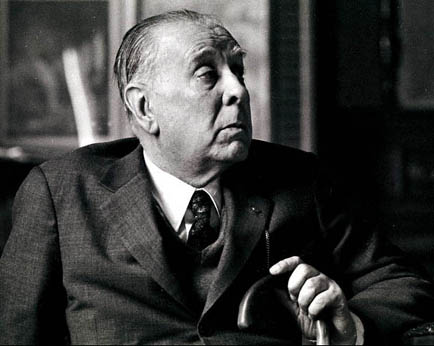
What good economists think is that the assumption of rationality can be a very powerful tool in explaining behaviour. It is a simplification, of course, but without simplifications, no theory has any explanatory power. In that respect, I would like to mention a short story by the Argentinian writer Jorge Luis Borges (in the photo above). In On Rigour in Science, Borges told the story of an empire, whose scientists, after generations, build a map of the kingdom in 1:1 scale. The map was a totally accurate description of reality. But what would be the use of such a map? Absolutely none. The assumption of rationality, Economics in itself, is a map of human and social phenomena. There may be some maps better than others, and we should strive to improve the ones we have, but without them, we will certainly get lost.
(To be continued).
Monday, 5 October 2009
The Love Of Money
 In the discussion panel on the Credit crunch, organized by the Economics Society about a year ago, my colleague Sevi Rodriguez-Mora pointed out, quite rightly, that most of what we could say about the crisis was just to descibe its chronology. At that moment, it was not very clear what caused it, and to some extent, that it is still the case (many entries in this blog has focused on this topic). The recent three-part BBC documentary The Love of Money illustrates perfectly this problem. Two of its parts ("The bank that bust the world" and "Back from the brink") recount the events that preceded and followed the fall of Lehman Brothers on 15th September 2008, widely considered as the starting point of the crisis. That "journalistic" narrative is interesting to a certain extent, but ultimately unsatisfactory to any economist who wants to understand the actual causes of the crisis.
The middle part of the programme, "The Age of Risk", does a much better job at uncovering the causes of the financial meltdown we experienced a year ago. According to it, its main culprit was Alan Greenspan. In the documentary, his career from just an unknown economists to head of the Federal Reserve is paralleled to the rise of the belief on self-regulating markets. The last five minutes of the programme are especially revealing. There, a tired and defeated Greenspan confesses that he still does not understand what went wrong. His surprise and disbelief is, at the same time, very telling, and very moving. It is probably the highlight of this interesting programme.
The website for the programme is here. You can watch each individual episode just by clicking on the links above. And then answer, is Greenspan to blame?
Thursday, 1 October 2009

Sunday, 27 September 2009
Intermezzo: Writing about economics in another (more exotic?) language
 I guess most of you have heard of Nikkei, which is known for the stock market index Nikkei 225 (it's like a Japanese version of FTSE100). Nikkei is actually a Japanese newspaper that sells 3 million copies (= three times as many as FT, incidentally) every weekday. It has a daily column on research in economics, and recently I wrote eight short pieces on "economics of communication" for the column, of course in Japanese.
It was a challenging but interesting experience. I am a native speaker of Japanese (and highly non-native speaker of English as some of you may know) so in principle it should be easier for me to write in Japanese. But I found it really hard. I think there are two reasons for it. The first is that I didn't know much of the Japanese economics jargon because my serious economics training was almost all in English. The second, which is related but much more serious, is that there are no Japanese translations for many terms in the first place. Let me give two (of many) examples.
To begin with, a half of what I wrote was about (the game theoretic analysis of) "cheap talk" but even now I still don't know how to translate it. Because it's a short phrase, I spelled the English pronunciation with Japanese characters like "chiipu toku", and fortunately the column editor liked the sound. It may well have been the very first time the term "chiipu toku" ever appeared in Japanese mass media.
The other half was about "verifiable disclosure", but again no translation for this term seemed to exist. It would be too long and awkward if I spelled the sound, so I really had to come up with a translation. There is a nice established Japanese translation for "disclosure" but there are a few equally good candidates for the word "verifiable" in that context. So I chose one that sounded best to myself. If my translation of "verifiable disclosure" becomes commonly used in Japan (at least among academics), then I should get credit for it!
Wednesday, 23 September 2009
How/If Economists Got the Crisis All Wrong
Financial Crisis brought down not only the banks but led to questions on whether economists are to blame for all this mess. Below are two very different views of whether Economists are at fault for the crisis in a highly politically charged essays from a Nobel Laureat and a Professor of Economics at Princeton University Paul Krugman and a Professor of Economics at the University of Chicago Booth School of Business John Cochrane.
On September 2, 2009 PAUL KRUGMAN in an article How Did Economists Get It So Wrong? wrote:
Krugman then goes on to answer "What happened to the economics profession? And where does it go from here?" questions, and concludes that
"It’s much harder to say where the economics profession goes from here. But what’s almost certain is that economists will have to learn to live with messiness. That is, they will have to acknowledge the importance of irrational and often unpredictable behavior, face up to the often idiosyncratic imperfections of markets and accept that an elegant economic “theory of everything” is a long way off. In practical terms, this will translate into more cautious policy advice — and a reduced willingness to dismantle economic safeguards in the faith that markets will solve all problems." (to read more click here)
John Cochrane responded to Paul Krugman's accusations on September 11th, 2009 saying that
On September 2, 2009 PAUL KRUGMAN in an article How Did Economists Get It So Wrong? wrote:
"It’s hard to believe now, but not long ago economists were congratulating themselves over the success of their field. Those successes — or so they believed — were both theoretical and practical, leading to a golden era for the profession... Last year, everything came apart. Few economists saw our current crisis coming, but this predictive failure was the least of the field’s problems. More important was the profession’s blindness to the very possibility of catastrophic failures in a market economy."
Krugman then goes on to answer "What happened to the economics profession? And where does it go from here?" questions, and concludes that
"It’s much harder to say where the economics profession goes from here. But what’s almost certain is that economists will have to learn to live with messiness. That is, they will have to acknowledge the importance of irrational and often unpredictable behavior, face up to the often idiosyncratic imperfections of markets and accept that an elegant economic “theory of everything” is a long way off. In practical terms, this will translate into more cautious policy advice — and a reduced willingness to dismantle economic safeguards in the faith that markets will solve all problems." (to read more click here)
John Cochrane responded to Paul Krugman's accusations on September 11th, 2009 saying that
"Paul Krugman has no interesting ideas whatsoever about what caused our current financial and economic problems, what policies might have prevented it, or what might help us in the future, and he has no contact with people who do. “Irrationality” and “spend like a drunken sailor” are pretty superficial compared to all the fascinating things economists are writing about it these days."he goes on to say:
"Again, what is the alternative? Does Krugman really think we can make progress on his – and my – agenda for economic and financial research — understanding frictions, imperfect markets, complex human behavior, institutional rigidities – by reverting to a literary style of exposition, and abandoning the attempt to compare theories quantitatively against data? Against the worldwide tide of quantification in all fields of human endeavor (read “Moneyball”) is there any real hope that this will work in economics?
No, the problem is that we don’t have enough math. Math in economics serves to keep the logic straight, to make sure that the “then” really does follow the “if,” which it so frequently does not if you just write prose. The challenge is how hard it is to write down explicit artificial economies with these ingredients, actually solve them, in order to see what makes them tick. Frictions are just bloody hard with the mathematical tools we have now." if you wan to read more click here.
Tuesday, 22 September 2009
Selfish basterds: On rationality in Economics (I)
 In this series of entries, I would like to reflect on the assumption of rationality in Economics. By using my personal experience and some elements from economic theory, I will discuss the common misconceptions on Economics, economists and rationality. Today, I will start with some personal anecdotes.
In my MSc dissertation, I worked with a model of coalition formation in which individuals differed in resources and abilities and could get together in order to produce output. Over and over again, I found that in the equilibrium of that model the more able agents formed groups with other able agents and that the group structure was ordered in that way. I say that I got that result over and over again because I found it outrageous so I checked and rechecked my computations. I did not like the fact that MY model yielded a hierarchical world in which people ended up merging with people similar to them and the less able and less rich got excluded. The fact was that I was letting my personal ideas obscure my economic thinking.
A few years later, I was a recently appointed lecturer at the University of Edinburgh and I was about to run my first economic experiment. As part of the process, I had to find subjects. I resorted to traditional methods like posters, showing up at the beginnning of lectures and distributing flyers across George Square. Students mostly liked the idea of being paid £10 for an hour of their time so the experience of chatting them up was pleasant. However, I remember vividly the visceral reaction of one female student. When I told her that we were looking for people to participate in research in Economics she answered "I hate Economics, I don't want to have anything to do with it. It's hideous."
Since last year, I have taught game theory on the MSc on Carbon Management that we run jointly with the Business School and Geosciences. I performed a simple classroom experiment in which students in the course played a public good game. They had to decide whether to contribute towards a public fund or not. Individual payoffs (I actually paid them in cash) increase with the number of contributors if you contribute too, but they increase even faster if you remain out. In equilibrium everybody should free-ride. Most students were shocked to find that, indeed, very few of them contributed. They thought that the world, and even themselves, was different. But once they felt the power of incentives, they were the first ones in leaving moral self-images aside.
Last Spring, I gave a workshop on economic experiments to students interested in the topic. I reported one experiment ("The Competitive Advantage of Sanctioning Institutions," O. Gürerk, B. Irlenbusch and B. Rockenbach, Science, 2006), in which subjects had to choose whether to play the game above or another version in which after contributions decisions are made, they could punish others at a cost. As you can expect, contributions are typically much higher in the latter case. I asked the audience which game they thought that subjects selected more often in the first round of the experiment. They all answered "the one with punishments". They were dismayed to find that it was actually in the other way around and that contributions were very low. I asked one student why she answered in the way she did. She replied "because that is how I would like the world to be, a world where people are nice".
So the moral of this first post is the following: Don't let your good feelings mix up with your Economics. Otherwise you will not be doing a good service to yourself nor to the world.
Only if you are ready to abandon your prejudices and your self-image as a saint, then you can continue reading.
(to be continued)
Subscribe to:
Posts (Atom)

 Posts
Posts


